🎧 Tech Thursday: Sound as a Lifestyle — Marshall Monitor II ANC, decibel science, and the art of protecting the mind you take most for granted
Tech Thursday / Smart Life
There is a moment I return to, over and over again.
It’s not a dramatic moment. It’s small, almost ceremonial. I sit down at my desk early in the morning — or in the studio on a Saturday — grab my Marshall Monitor II ANC, put them over my ears, and press play. And then something strange happens: the world goes silent, the music starts, and everything that was fragmented and rushed in my head settles down in a precise moment. Focus doesn’t happen as a decision — it happens as an exchange of breath.
I've been wearing these headphones for a long time now. And this post isn't your average product review. It's a story about sound, about hearing, about what the research actually says about what we put our ears through — and why we should care a lot more about that mind than we do.
From guitar case to ears — Marshall's unusual legacy
To understand why a pair of Marshall headphones feels different on your ears, you need to know who built them.
Marshall was founded in 1962 in London by Jim Marshall — a drummer who opened a music store, and soon realized that the guitarists who came in weren't finding the sound they were looking for in the existing amplifiers. What followed is music history: early Marshall amps were adopted by Jimi Hendrix, Eric Clapton, Pete Townshend and Jimmy Page, and fundamentally shaped the sound we associate with rock music today.
Marshall amplifiers made possible the stadium-filling, powerful crunch sound we now associate with rock — and created not just a new tonal palette, but an entirely new concert experience.
It's that legacy that carries on into every product that bears the white Marshall logo today — including the Monitor II ANC. It's not marketing. It's a genuine craftsmanship in listening philosophy that goes back more than 60 years.
What Monitor II ANC actually does — and why it's smart tech
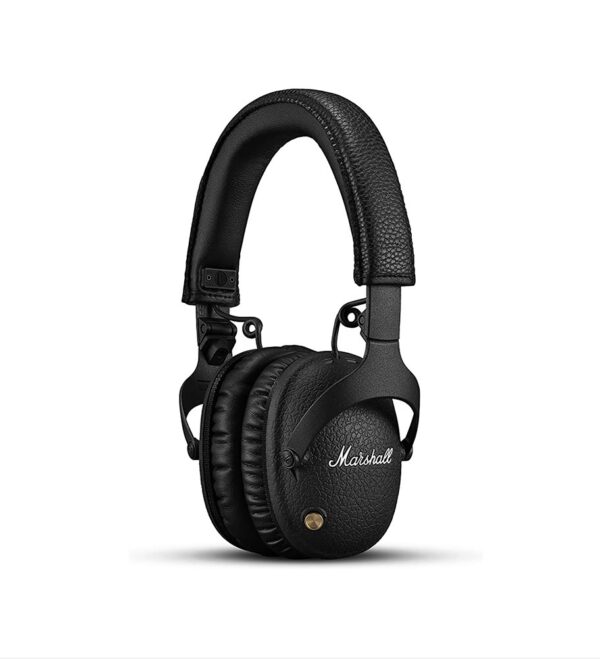
The Marshall Monitor II ANC is equipped with custom-designed 40mm dynamic drivers that deliver crisp highs, powerful mids, and deep bass — balanced and clear at any volume. But what makes them particularly interesting from a Smart Liv perspective is the active noise cancellation.
Four built-in microphones continuously measure ambient sound and automatically adjust the noise cancellation level — so you can focus on what really matters. And via the Marshall Bluetooth app, you can control how much of your surroundings you want to let in, with a transparency mode that goes from 0 to 100 percent. It’s a nice touch: you don’t just choose what you hear — you choose how much of the world you want to be a part of, moment by moment.
Battery life is one of the headphones' strong points: up to 45 hours wirelessly without noise cancellation activated, and 30 hours with it on — they seem to last forever.
They fold up compactly, are built from premium materials, and look unique in a subtle way — elegant rather than flashy, with a retro-inspired look that nods to the iconic leather aesthetic of Marshall amps.
And like their amplifier ancestors, they retain a 3.5mm jack — a small but thoughtful choice in an increasingly wireless world.
Decibel — the measurement we should understand as well as calories
Now to the part of this post that I consider to be as important as the presentation of the headset itself.
We measure what we eat. We measure sleep. We measure steps and heart rate and stress levels. But how often do we measure what we put in our ears?
Sound is measured in decibels (dB) — and it’s important to understand that it’s a logarithmic scale. That means it’s not linear. An increase from 80 dB to 90 dB isn’t just a little louder — it’s ten times more intense to the ears and feels about twice as loud.
Some reference points to keep in mind:
• Below 70 dB — safe for unlimited daily exposure (a typical conversation is about 60 dB)
• 80–85 dB — the borderline zone. The WHO considers 80 dB to be the safe limit for an eight-hour workday.
• 100–110 dB — the maximum volume on most personal listening devices. At that level, hearing damage can occur in just five minutes.
Headphones and earbuds can reach up to 100 dB or more, so a safe volume is 50 to 60 percent of maximum volume.
And here's one of the most practical guidelines you can take away from this post: Lowering the volume by just 3 decibels halves your risk of hearing damage. Three decibels. That's barely audible — but to your ears, it's crucial.
How common is it really — damaging your hearing with headphones?
More common than we think, and it's increasing.
Based on CDC studies, it is estimated that at least 10 million adults in the United States under the age of 70 have evidence of hearing damage in one or both ears from exposure to loud noise — and possibly up to 40 million, or 24 percent of all adults under 70.
The BMJ estimates that over a billion young people are at risk of preventable, noise-induced hearing damage.
This is a generation that grew up with earbuds in their ears, streaming music 24/7, and podcasts as lullabies. And hearing loss is silent — it creeps up on you, and by the time you notice it, the damage is already done.
Noise-induced hearing loss (NIHL) is the second most common cause of sensorineural hearing loss after age-related hearing loss, and affects approximately 5 percent of the world's population.
Sweden: A ticking public health bomb we're not talking about
It's easy to think of hearing loss as something that affects others — the elderly, industrial workers, concertgoers. But the numbers from Sweden tell a different story.
According to a new Novus survey commissioned by the Swedish National Association of the Hearing Impaired (HRF), approximately 1.7 million people in Sweden have a hearing loss — that’s one in five adults. HRF’s chairman, Ulf Olsson, commented on the figures with the words: “There’s a ticking public health bomb here.”
Although just over 700,000 people report using hearing aids, the number should be well over a million — meaning more than half of those who need help go without.
And the waiting times? In twelve of the country's 21 regions, the waiting time for hearing aids is between one and three years. HRF describes the situation as catastrophic — and notes that “the crisis in hearing care today will be felt in dementia care tomorrow.”
It's a sentence that sticks.
Young Swedes — a generation at risk
Among young adults in Sweden between the ages of 18 and 29, 35 percent of women and 30 percent of men say they listen to loud music daily. That's not a small group — it's an entire generation that wears headphones as an extension of themselves.
Research from Örebro University shows how deeply ingrained the behavior is. Young people listen to music for large parts of the day — some even sleep with headphones in their ears. Listening to music can start as early as the age of 8–9, and for many it takes up large parts of the day.
Researcher Iris Elmazoska at Örebro University points out that young people are aware of the risks of high volume — but they don't always understand the consequences for hearing. It's an important distinction: knowing and understanding are two completely different things.
A study published in Läkartidningen highlights that young people can turn up the headphone volume to 105 dB — a level that exceeds limits for safe exposure after just a few minutes. Among the approximately one million Swedes aged 15–30 who are exposed to music in hearing-damaging doses, many are believed to have developed hearing problems that have not yet manifested.
And in the labor market: noise is the third most common cause of an approved occupational disease in Sweden, according to Afa Insurance — and it often takes several decades before the damage becomes apparent.
What recent research has revealed — and should change the way we look at hearing care
The most surprising — and most compelling — argument for taking hearing seriously isn't even noise itself. It's what hearing loss does to the brain.
The Lancet Commission report in 2024 identified hearing loss as the single largest modifiable risk factor for dementia among middle-aged adults. That's a remarkable claim. Not one of several factors — the largest.
Research from Imperial College London shows that hearing loss in middle age doubles the risk of developing dementia — more than any other single factor.
And there is now concrete evidence that treatment actually helps. The ACHIEVE study — the largest randomized controlled trial to date of hearing aids to reduce cognitive decline — found that in a subgroup of older adults with hearing loss and an increased risk of cognitive decline, using hearing aids for three years halved cognitive decline.
An Australian longitudinal study that followed 1,846 participants over 12 years found that hearing aid use was linked to a 19 percent lower rate of cognitive decline.
Why? One of the leading explanations is that people with hearing loss spend more cognitive energy on listening — and that energy is taken at the expense of other cognitive functions. The brain compensates, and it costs.
What does the ANC have to do with all this?
It's actually a direct connection — and one of the most compelling reasons to choose noise-canceling headphones.
The WHO specifically recommends using noise-canceling and well-fitting headphones to reduce the need to turn up the volume in noisy environments.
That's the logic behind ANC from a health perspective: instead of turning up the volume to drown out the metro, train, café or open office landscape — noise reduction lets you listen at a lower and safer volume. You're not shutting out the world to be antisocial. You're protecting the hair cells in your inner ear that never grow back once they're damaged.
Marshall's Monitor II ANC does exactly that job. It removes the background noise that otherwise forces you to turn up the volume, and lets the music reach you on your terms — at a level that's gentler on the organ that makes the whole experience possible.
Smart listening as part of a Smart Life
When we talk about Smart Living — which we do every Thursday at Amaelle Life — it's not just about gadgets and productivity hacks. It's about thoughtful choices in how we live with the technology we surround ourselves with.
Some simple principles to build into your everyday life:
The 60/60 rule. Keep the volume at a maximum of 60 percent and take a break after 60 minutes of continuous listening. It's not a sacrifice — it's a micro-choice that accumulates into years of hearing protection.
The Arm Length Test. Hold the headphones an arm's length away while music is playing. If you can still hear it clearly, the volume is probably too high.
Listen for warning signs. Ringing in the ears after a listening session (tinnitus), muffled sound, difficulty hearing high frequencies — it's your body's way of communicating that something is wrong.
Use ANC actively. Noise cancellation is not a luxury — it's a health strategy.
In conclusion: Hearing is one of the quietest health issues we carry.
We talk about eating habits, exercise, sleep, mental health. But hearing — the sense that connects us to music, to conversation, to the richness of the world around us — we almost always take for granted until it's too late.
I choose the Marshall Monitor II ANC not just because they sound amazing — they do — but because they represent a thoughtful approach to sound. They're a pair of headphones with a heritage that stretches back to Jimi Hendrix and Clapton, to amp halls and a '60s London that was in the process of reinventing rock music.
But they are worn by me, on a Tuesday morning, in my studio, with the volume at 55 percent — and with my ears intact.
It's Smart Life.
- Maria
Sources:
• World Health Organization (WHO) — Safe Listening Guidelines
• Hearing Health Foundation — Decibel & Hearing Loss Statistics
• Harvard Health Publishing — Healthy Headphone Use
• National Institute on Deafness and Other Communication Disorders (NIDCD), CDC
• Lancet Commission on Dementia Prevention, 2024
• ACHIEVE Study, Alzheimer's Association International Conference 2023
• Natarajan, Batts & Stankovic, Journal of Clinical Medicine 2023 — Noise-Induced Hearing Loss
• Azeem et al., Frontiers in Dementia 2023 — Hearing Loss and Cognitive Decline
• Marshall.com — Monitor II ANC product specifications