Incredible Wednesday · Wonderful Wednesday · Nourishing
There is a food that has always been around. Not trendy. Not invented by an influencer or launched by a Silicon Valley startup. Kimchi has been around for over 2,000 years — and if you haven't yet made it a part of your everyday life, this post is written for you.
We're talking gut health today. Not in a dry, scientific way — but in the way that actually changes how you feel, how you think, how you sleep, and how your body stays strong year after year. We're talking about the living ecosystem that lives inside you. And we're talking about a spicy, tangy, deeply flavorful dish that's one of the best ways to strengthen that ecosystem.
Welcome to Wednesday's table.
The gut flora — your second brain
Before we talk kimchi, we need to understand why it matters.
Your gastrointestinal system is home to about 38 trillion microorganisms — bacteria, fungi, viruses, and single-celled microorganisms (archaea) — collectively known as your gut flora, or microbiome. That’s more cells than you have human cells in your entire body. They weigh about 3 pounds. And they control more than most of us realize.
The gut is increasingly being called the second brain — not metaphorically, but anatomically. The gut's own nervous system, the enteric nervous system, contains up to 500 million nerve cells and constantly communicates with the brain via the vagus nerve. Research from, among others, Karolinska Institutet and the University of California shows that the composition of the gut flora affects:
• Mood and anxiety levels • Sleep quality • Inflammation levels throughout the body • Immune system strength (70–80% of the immune system is in the gut) • Metabolism and weight control • Cognitive function and concentrationDr. Emeran Mayer, gastroenterologist and author of The Mind-Gut Connection, describes it this way: the gut is not just a tube that processes food. It is an emotional organ that stores memories, responds to stress, and shapes our experience of the world.
And what feeds a healthy microbiome best? Fermented foods. Live foods. Kimchi.
What is kimchi, really?
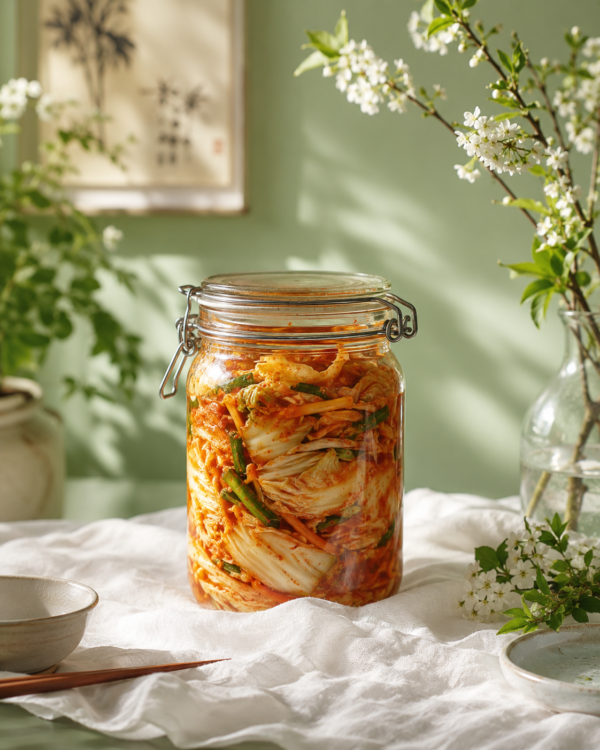
Kimchi is the Korean answer to the raw materials of life — Chinese cabbage (also Napa cabbage), radish, scallions, garlic, ginger and gochugaru (Korean chili) fermented together with salt in a process called lacto-fermentation.
It's one of the world's oldest preservation methods. No heat. No vinegar. Just salt, vegetables and time — and the naturally occurring lactic acid bacteria Lactobacillus that begin to convert the sugar in the vegetables into lactic acid.
It's the lactic acid that gives kimchi its characteristic sour taste. But it's the live bacteria — probiotics — that make it more than just food. It's medicine in a glass jar.
Korea has identified kimchi as part of its intangible cultural heritage, and in 2013 the Korean kimchi tradition, Kimjang, was granted UNESCO status. It is a dish that unites generations, neighbors, and seasons. But it is also, modern research shows, one of the most powerful functional foods we know.
What does the research say?
Probiotics and microbiome diversity
A study published in Cell (Wastyk et al., 2021) from Stanford University showed that a highly fermented diet — including kimchi, kefir, and sauerkraut — significantly increased microbiome diversity and reduced inflammatory markers after just 10 weeks. A rich microbiome is one of the strongest signs of gut health: the more diverse the species, the more resilient and functional the gut.
Kimchi primarily contains bacteria from the Lactobacillus family — specifically L. plantarum, L. brevis, and L. sakei — which are well-documented for their ability to:
• Colonize the intestine and outcompete pathogenic bacteria • Strengthen the barrier function of the intestinal epithelium • Modulate immune responses • Produce short-chain fatty acids (SCFA) such as butyrate, which is the primary fuel for intestinal cellsAnti-inflammatory effect
The fermentation process transforms kimchi's ingredients into a complex soup of bioactive compounds. Research from Seoul National University has shown that regular kimchi consumption lowered levels of CRP (C-reactive protein) — one of the most important blood markers of systemic inflammation — in test participants with elevated starting levels.
Inflammation is at the root of most chronic diseases — heart disease, type 2 diabetes, depression, dementia. Keeping inflammation low isn't just good for your gut. It's one of the most important things you can do for a long, healthy life.
The immune system
A Korean study (Kim et al., 2014) showed that kimchi fermentation increased the activity of natural killer cells (NK cells) — frontline defenders against viruses and cancer cells. Another study suggested that kimchi’s bioactive components may have a protective effect against influenza A virus. Furthermore, during the Covid-19 pandemic, epidemiological observations were made around countries with high fermented food consumption and lower mortality risk — no proven causal relationship, but data that raises questions.
The intestinal barrier and leaky gut
“Leaky gut” — or intestinal permeability — is a condition in which the intestinal walls become permeable, allowing unwanted substances to pass into the bloodstream. It is linked to autoimmune diseases, eczema, chronic fatigue, and systemic inflammation.
Research suggests that kimchi's probiotics — especially L. plantarum — strengthen tight junctions, the protein connections that hold intestinal cells together. A healthy intestinal barrier is the foundation for everything else.
The Ann Wigmore perspective — living food as medicine
Ann Wigmore, the founder of what came to be known as the living food movement and the Hippocrates Health Institute, understood something that mainstream medicine took decades to acknowledge: the food we eat is information to the body.
Wigmore was already working in the 1950s and 60s with fermented vegetables, sprouted foods and rejuvelac (fermented grain water) as a basis for healing — not as a supplement, but as a primary food. Her philosophy: give the body live enzymes, live bacteria and bioactive compounds, and the body knows what to do with them.
Kimchi is exactly the kind of food Wigmore advocated. It's raw (not heated, which would kill the bacteria). It's fermented (enzymatically richer than fresh produce). It's packed with phytonutrients from cabbage, garlic, and ginger. And it's alive — each jar a little ecosystem.
In Amaelle's food philosophy — Wonderful Wednesday — Wednesday is about truly nourishing yourself. Not eating to fill you up. Eating to build you up. Kimchi is a Wigmore dish if ever there was one.
Bryan Johnson — and the biohacker's perspective on gut health
Bryan Johnson, the tech billionaire who became the world's most famous biohacker through his Blueprint project, spends millions of dollars a year measuring and optimizing his biology. His goal: to have the youngest organs measurable in the body. And the gut is central to his protocol.
Johnson includes fermented vegetables as a daily component of his diet — not because it’s trendy, but because the biomarkers demand it. His CRP levels, gut flora diversity, and inflammation status are measured regularly, and fermented foods are one of the interventions that consistently show positive impact in his data.
Johnson talks about the gut microbiome as an investment: “You want compound interest on your gut bacteria just like you want it in your portfolio.” It takes time to build a rich microbiome. Every day you eat fermented foods, live vegetables, and prebiotic fibers — you’re investing in your health. Every day you eat ultra-processed foods, sugar, and stress — you’re taking money out of your health account.
It's a metaphor that fits perfectly on a Trade Tuesday. But it's actually a strategy we're starting to use on Incredible Wednesday.
Practical: How much kimchi do you need?
The research is clear: you don't need to eat kimchi in industrial quantities. The studies that have shown the clearest effect on microbiome diversity and inflammation have used servings of 2–5 tablespoons per day — about 50–100 grams.
That's enough. It's about a serving spoonful as a side dish for lunch or dinner. It's a dab on top of a buddha bowl. It's a bite before you sit down at your desk.
Important: Never heat kimchi if you want the probiotic effect. Put it cold on the plate, next to the hot one. Heat kills the live bacteria.
Start small if you're not used to it. Your gut needs to adjust — you may experience some gas in the first few days. That's normal. It's the ecosystem adjusting.
Where can you buy kimchi in Sweden?
You can find ready-made kimchi today at most larger ICA, Coop and Willys stores with a well-stocked Asian assortment — look in the refrigerated counter, not the shelf. Refrigerated kimchi is live kimchi. Kimchi at shelf temperature is pasteurized and lacks the live bacteria.
Good brands to look for:
• Funch (Swedish, organic, found at Paradiset, Linas Matkasse and others) • Mother-in-Law's Kimchi (imported, high quality) • Korean grocery stores in Stockholm, Gothenburg and Malmö — homemade kimchi is always bestOr — and this I heartily recommend — make your own.
The recipe: Classic Kimchi at home — simple and vibrant
There's something deeply satisfying about making kimchi at home. It smells. It bubbles. It's alive. And it tastes in a way that no store-bought kimchi can quite match after a week in your fridge.
This is a recipe for beginners — not the most authentic Korean recipe (it often calls for shrimp sauce and oyster sauce), but one that gives you a fantastic kimchi without animal products and with ingredients you can find in any Swedish grocery store.
🥬 Homemade Kimchi — Incredible Wednesday Version
Time: 30 min active time + 1–5 days fermentation
Yield: About 1 liter of kimchi
Shelf life: 3–6 months in the refrigerator (gets better with time)
You need:
Cabbage and salting:
• 1 Chinese cabbage/Napa cabbage (approx. 1 kg) • 3–4 tbsp coarse sea salt (not iodized — iodine inhibits fermentation)Kimchi paste:
• 4–5 cloves garlic, grated • 1 tsp fresh ginger, grated • 2–3 tbsp gochugaru (Korean chili powder — found at Asian stores or online) • 1 tbsp tamari or soy sauce (for umami) • 1 tsp raw sugar or a small piece of grated pear/apple (feeds the fermentation) • 3 spring onions, cut into 3 cm pieces • 1 small carrot, juliennedDo this:
- Salt the cabbage
Quarter the cabbage lengthwise, then cut into bite-sized pieces (about 2 inches (5 cm). Place in a large bowl. Sprinkle with salt and massage well into the cabbage for 5–10 minutes — until it begins to soften and liquefy. Cover and let stand for 1–2 hours at room temperature (or overnight in the refrigerator). - Rinse and squeeze
Rinse the cabbage in cold water 2–3 times to remove excess salt. Taste — it should be salty, but not overly so. Squeeze out as much water as possible with your hands. - Make the pasta
Mix garlic, ginger, gochugaru, tamari and sugar into a paste. Taste — it should be hot, slightly sweet, deeply flavorful. Wear gloves if you have sensitive skin (chili + garlic = intense). - Mix everything
Place cabbage, scallions, and carrots in the bowl. Add the pasta and massage it into the vegetables until everything is evenly coated. Take your time here — it's a meditative moment. - Pack in a jar
Pack the kimchi tightly into a clean glass jar (1 liter). Press down firmly so that the liquid rises and covers the vegetables. Leave about 2–3 cm of space for the lid — the kimchi expands during fermentation. - Ferment
Leave the jar at room temperature (18–22°C) for 1–5 days. Open and press down on the vegetables once a day — this is called “burping the jar” and releases carbon dioxide. Taste daily. Day 1: fresh and hot. Day 3: starting to settle. Day 5: tangy, complex, deep. Refrigerate when it tastes right to you.
Serve:
• As a side dish for rice, bouddha bowl, scrambled eggs • On top of avocado toast with sesame seeds • In a green smoothie (a little kimchi juice = probiotic boost without dominating the taste) • As is, with a spoon — your stomach knows what to doSummary — remember this
Kimchi is not a health trend. It's a 2,000-year-old answer to a fundamental question: how do we best nourish our bodies?
Modern research confirms what Ann Wigmore knew intuitively, what Bryan Johnson measured obsessively, and what Korean home cooks practiced for generations: live, fermented foods are one of the most powerful things you can put on your plate.
It strengthens the gut. It reduces inflammation. It trains the immune system. It feeds your microbiome. And it tastes amazing.
Start small. A tablespoon a day. Cold, on the side of hot. Make it a habit. Let your gut adjust. And if you feel like it — make your own. Feel how it bubbles. See how it lives.
It's truly Incredible Wednesday.
Have you tried making kimchi at home — or are you the buyer who hasn't taken the plunge yet? Tell us in the comments — I'm curious to know where you are in your kimchi journey.
// Maria, Amaelle Life · Incredible Wednesday · Nourishing