INCREDIBLE WEDNESDAY — NOURISHING
It starts in the store.
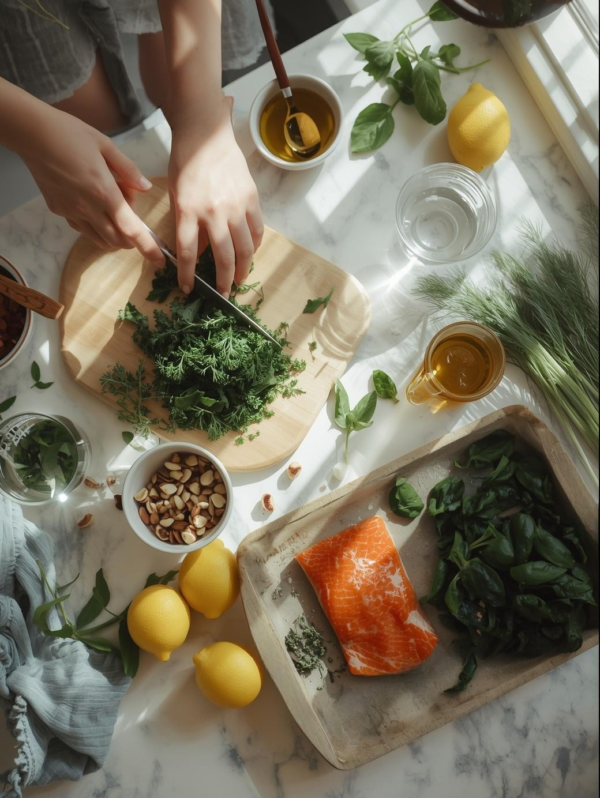
Not with a list of calories or macros. With presence. With hands that feel a head of cabbage, noses that draw in the scent of fresh basil, eyes that linger on the deep green color of a handful of spinach or the shiny surface of a piece of wild-caught salmon.
This is where cooking begins — long before you set foot in the kitchen.
I choose organic when I can. Not out of prestige, but out of logic. Organic ingredients don't carry pesticide residues that the body then has to deal with. In many cases, they have higher levels of polyphenols and antioxidants — because plants that have to fight a little against their environment build up their own defense substances, and then we eat them. It's an elegant chain. Nature is smart.
The senses awaken
Do you know what happens when you start chopping onions?
The nervous system is activated. The scent reaches the brain's limbic system — the oldest, most primitive layer — and triggers memories, emotions, associations. Taste and smell are the only senses with a direct line to the hippocampus, our memory center. That's why a scent can take you back to Grandma's kitchen in an instant.
But it doesn't stop there. Motor skills are engaged — cutting, moving, turning, shaping. The brain's motor cortex and cerebellum work in unison. Research shows that regular fine motor skills in the hands actually protect against cognitive decline. You're exercising your brain while you peel carrots. That's not metaphor. That's neurology.
Standing in the kitchen and cooking from scratch is one of the most complete activities a human can engage in. You plan (prefrontal cortex), you remember recipes and techniques (hippocampus), you coordinate movements (motor cortex + cerebellum), you smell and taste (limbic system), you adjust and improvise (executive function). The whole brain is on.
What happens to food when you cook it properly?
Here's something most people don't think about: the cooking method determines how much nutrition actually reaches the cells.
Steaming preserves water-soluble vitamins — vitamin C and B vitamins stay in the vegetable instead of disappearing into the cooking water. That’s why I love my steamer. Light sautéing in good oil releases fat-soluble vitamins like A, D, E, and K. Fermentation — like in kimchi, sauerkraut, or kefir — multiplies probiotics and increases the bioavailability of minerals like iron and zinc.
Ann Wigmore, the pioneer of living foods and founder of the Hippocrates Health Institute, understood this early on. She cured her own illness with raw foods, sprouted foods, and wheatgrass juice, and then dedicated her life to showing others the way. Her insight was simple and radical: the body heals itself when given the right fuel. Living foods carry enzymes that aid digestion. Heat destroys enzymes. Balance is everything.
I am a trained raw foodist — and I listen to the wisdom. Green smoothie in the morning. Raw vegetables in the salad bowl on the side. Lightly steamed broccoli or completely raw instead of mashed. It's about understanding what heat does and choosing thoughtfully.
No E-numbers. No additives. Just food.
Look at the ingredients list on a bread made in an industrial oven. Count the ingredients. Twenty, thirty, forty substances. Emulsifiers like E471 and E472 that studies are now linking to disruptions in the gut flora. Preservatives that extend shelf life but that the body doesn't know what to do with. Flavor enhancers that disrupt the brain's reward system and make it difficult to be satisfied with real food.
When you cook from scratch, all that goes away. You know exactly what's in your food, because you put it in yourself. It's a type of control that's deeply satisfying — and one that researchers now understand has direct effects on gut health, the immune system, and even mood via the gut-brain axis.
The gut and brain are constantly talking to each other via the vagus nerve. About 90% of serotonin — your feel-good hormone — is produced in the gut. What you eat affects how you feel mentally. It's not new age. It's established neuroscience.
Blue Zones and the Secret of the Mediterranean Diet
The five Blue Zones — Sardinia, Okinawa, Nicoya, Ikaria, Loma Linda — have fascinated researchers for decades. What do they have in common, these places where people regularly live to be 100 years old with good health and sharp minds?
They cook their own food. From scratch. Every day.
On Ikaria in Greece, they eat wild food — herbs, vegetables, legumes — cooked simply with olive oil and love. In Sardinia, it's bread baked with durum wheat, pecorino made from local milk, red wines rich in polyphenols. In Okinawa, it's sweet potatoes, tofu, seaweed, and fermented vegetables. Different cuisines, the same principle: real food, cooked at home, eaten together.
The power of the Mediterranean diet is now among the most well-documented in nutritional research. The PREDIMED study — one of the largest randomized dietary experiments ever — showed that the Mediterranean diet with extra olive oil or nuts reduced the risk of cardiovascular events by almost 301%. But it's not just the heart. Studies show reduced risk of depression, better cognitive function, lower inflammation markers.
The essence? Olive oil. Fatty fish. Green leafy vegetables. Legumes. Nuts and seeds. Berries and fruit. Fermented dairy products. A little wine with your food. And — crucially — that the food is prepared and eaten with presence.
The economics of cooking from scratch
Here's a truth that's often forgotten in the discussion of organic, healthy food: it's actually cheaper to cook from scratch.
A salad bought at a restaurant costs 150-200 kronor. A homemade salad with quinoa, roasted chickpeas, avocado, spinach, walnuts and a homemade tahini dressing costs maybe 35 kronor. And it's better.
If you plan your week with Wednesday as your big planning and cooking day — like I do — you buy ingredients once, cook in advance, and have food ready for several days. The freezer is your friend. I buy legumes dry and soak them — dramatically cheaper than canned. Seasonal shopping means you get the tastiest things at the lowest price.
It's about seeing the kitchen as a joy, not a burden.
Presence is the ingredient you can't buy
There's something that happens when you're really in the kitchen. Not half-heartedly, with your phone in your hand and an eye on the news. But completely. Hands at work, your mind following.
It's a form of movement meditation. Flow, as psychologist Mihaly Csikszentmihalyi calls it — the state of complete absorption in an activity where time and worry dissolve. Cooking is one of the most common ways people spontaneously describe achieving flow.
Stress hormones drop. The parasympathetic nervous system — the rest-and-digest mode — is activated. Digestive enzymes begin to be produced as soon as you smell and see food being prepared. The body prepares itself. It's biology in motion.
And then there's the simple fact: you eat better when you cook your own food. Research consistently shows that people who cook at home consume fewer calories, more fiber, more micronutrients — without counting or making an effort. The process itself creates the right relationship with food.
My green love
I can't write about food without mentioning greens. It's my absolute love.
Dark green leafy vegetables — spinach, kale, Swiss chard, arugula, wild-picked — are nutritional powerhouses. Magnesium (most of us are magnesium deficient without knowing it). Folate. Vitamin K. Chlorophyll, which resembles hemoglobin at a molecular level and research suggests can support oxygen uptake in the blood.
And the ocean. Wild-caught fish and seafood are nature's most complete source of protein, packed with omega-3 fatty acids — EPA and DHA — that the brain is literally built of. DHA makes up 971% of the brain's omega-3 content. We are creatures of the ocean. We need the ocean on our plate.
Seaweed — nori, wakame, dulse — is one of the most mineral-dense foods there is. Iodine, selenium, iron, calcium. And they're delicious. The Japanese centenarians on Okinawa know it. Now we know it too.
Wednesday is my day
In the Amaelle universe, Wednesday is Wonderful Wednesday — Nourishing — and it’s kitchen day. I plan the week’s meals, shop thoughtfully, cook in advance. It’s not a must. It’s a choice I make for myself — for my brain, my body, and my energy for the entire week.
Cooking from scratch is one of the most tangible things you can do for your long-term health. It's researched. It's proven by cultures that live longer and better than us. It's logic in practice.
And it tastes wonderful.
What are you cooking from scratch today?
Please share in the comments — I'm genuinely curious.
– Mary